At planting time last year, we were amazed at all the earthworms and had to do a little research on them. We still a lot of earthworms; large, medium, and many babies. This Spring we have been seeing Armadillidida or commonly known as roly polys or pill bugs everywhere on our farm and lots of them. These “bugs” (they really aren’t bugs; keep reading and I’ll go further in-depth on that) have always been fun to find for the kids. They love seeing roly polys roll up when touched, which is a defense mechanism, then wait for them to unroll so they can touch them again and sometimes roll them around the palm of their hand.
We are seeing a whole lot more roly polys than we have in the past. So, of course, this lead to a little research project. Part because we love learning and part because we were wondering if they were beneficial or are they going to be pest. We were quite happy to learn that they are beneficial and help with the decomposing process. They eat decaying plant and animal material. We provided the organic matter and now they have moved in to help with the breaking down of the organic matter, to increase our soil fertility. Hurrah! We read that they could feed on seedlings and plant roots, but tend to eat decaying material when it is available. We have a lot of decaying plant material available and have not had any problems with them feeding on plant roots or seedlings. There are thousands in the cold frame where we have greens growing and started all of our seedlings. They haven’t kill any seedlings.
It was also quite interesting to learn that they are actually not a bug, they are a land crustacean and are related to shrimp. They like dark moist places and have gill-like structures used to breath, but can’t live underwater. They don’t urinate, but instead release an ammonia gas through their exoskeleton. And they shed their exoskeleton as they grow. The back half sheds first, then the front half. The females carry their eggs and newly hatched babies in a special pouch before they start crawling out to walk on their own. Huh. . . . the things we learn through hand-on activities and work with curious minds questioning everything! This little organic piece of Earth we live on just amazes us!


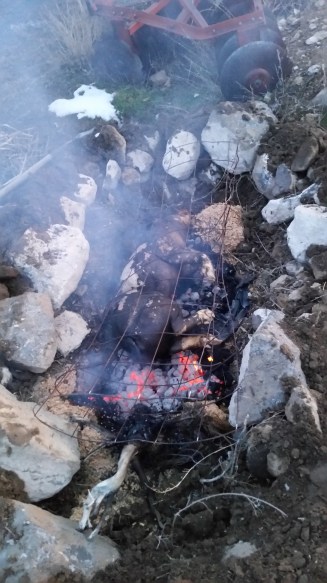 xperiment with roasting our first pig. Who doesn’t want to be invited to a party to eat an experiment?!!! Be aware before you read on, how we cooked this pig may sound or actually be a little redneck-ish, but, hey, that’s just how we are. We started it the night before in a pit we lined with rock. We started wood pellets and 10 pounds of charcoal briquets on fire and got it hot and cooked down. We torched the hair off the pig with a weed burner and wrapped the pig in woven wire and put it in the pit. Then cover the pig and pit with a piece of tin roofing. It cooked and smoked all night. We checked it periodically and rotated it a couple of times. We thought it was done at noon the next day, but we didn’t take it out of the pit until 3:30. The Farmer put the whole thing in a large cooler and brought it in the house. When we were ready to eat, we started cutting it up and taking chunks off. It was good, although, I like my meat well seasoned. So I can’t say it is my favorite way to eat pork. But it was a fun experience and very neat to have a whole roasted pig for all the guest to see before we ate.
 Agrarian Harvest