Search

Agrarian Harvest

Wholesome, Organic, Experience. Our small farm, food, and simple life.

Category

Produce

Low Tunnels

We are getting the low tunnels up and cool weather produce transplanted in the field. We decided to use low tunnels this year to extend our growing season, being able to plant earlier and then to allow our produce to grow later into the fall. Although, this spring has been warmer than usual and so far have not needed the low tunnels covered. We only have one row covered, thinking we would not need to cover them this spring since the temperature has been warm and staying about normal. Then last night it freezes. But so far all the plants have tolerated the frost and are doing fine.

The low tunnel technique seems to work well and we are very excited to be using them. This will allow us to be way more productive, which makes life a whole lot less stressful and allows us to laugh more often. We have started thousands of cool weather tolerant plants like broccoli, cabbage and kale in the cold frame several months ago and are now able to plant them outside. This frees up space in the cold frame for thousands of more seeds to be started of our later season plants like tomatoes and peppers. This has allowed us to start thousands of more seeds than in previous years. We are getting them planted in a timely manner and in stages. This makes us feel so much more efficient. We are so excited about this growing season.

DSCN7319

Spring Greens

The salad greens are thriving in the cold frame. We are very excited to be eating salad on a regular basis again! (Pictured is a mix of spring mix lettuce, arugula, and spinach.)

DSCN7355

The curly kale overwintered in the field and is growing. I love putting this kale in our smoothies. The kids even drink the smoothies. These green smoothies are becoming our go-to afternoon snack once again. We absolutely love this time of year when everything is greening up and starting to grow! We’ve even been going out into the yard and harvesting dandelion leaves to eat and for tea. It is simply that time of year when all greens are appealing!

DSCN7351

We sell all greens individual,  request a mix or buy a CSA share or half share and you won’t miss out on any of our produce.

Produce                                                                       Produce CSA


It’s a Good Friday!

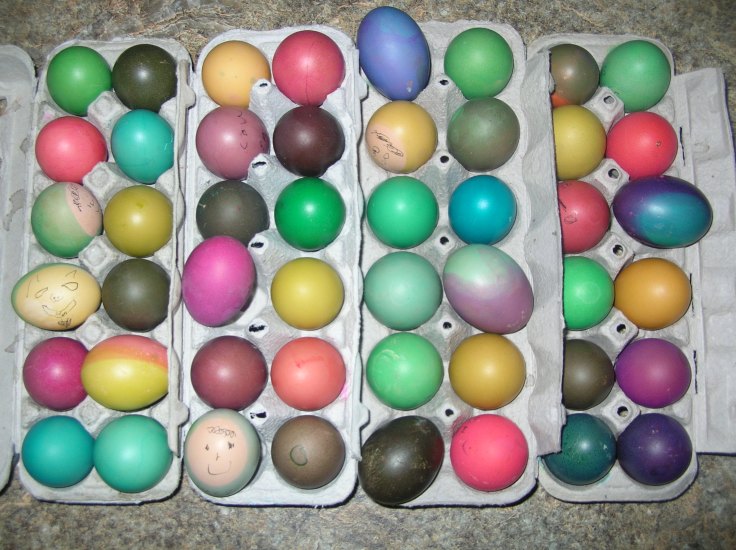
It’s a Good Friday! Our eggs are dyed and ready for Easter! If you haven’t got your eggs yet, it’s not too late. We still have eggs available. Look at the wonderful colors that brown eggs turn when dyed. Okay, so I have been told that my eggs are ugly. To defend myself, I’m just trying to keep a family tradition. I have a tradition on my side of the family to try to dye an egg black. So every year I use my patience and persistence, sitting at the table long after the kids have finished their eggs, trying to turn at least one egg black. Or as dark and ugly as I can get it. And it is so much fun for me!DSCN7294

This year the kids and Grandpa drew faces and names on some of the eggs, so they each have a special egg to hunt for on Easter. This might be the start of a new tradition.

It is a very happy Easter weekend at our farm. The eggs are colored, greens are ready, daffodils are blooming, the lawn and wheat field are green. It’s a weekend of miracles, faith, and happy times. We had arugula to eat and sell this past week and will have spinach and lettuce this week. It feels like Spring has truly sprung and it is time to be warm and full of smiles when I get to eat a homegrown green salad. And the time is here and now. Have a Good Friday and Happy Easter!

Check out our produce page for prices of greens and all of our other product pages!

Produce            Eggs              Produce CSA           Chicken        Pork             Hand-Made Soaps


Greens, Eggs, & CSA

It is so fitting that we ate our first greens (arugula) out of the cold frame on St Patrick’s Day. I have been craving the fresh, wholesome greens grown in our soil and this was the perfect day for our first taste!

We will have arugula available starting March 23th and the spinach should be close behind. Check our produce page for pricing. Produce

The days are longer and I’m not thrilled about losing sleep, but the chickens are loving it. Our egg production has increased, so we have plenty of eggs available, just in time for Easter. Try dying brown eggs this Easter or do some baking or just eat them. Eggs

Spring is almost here and so is the start of our Spring CSA and full season CSA. They start the second week of May, buy your share soon. Produce CSA

Email, call or text us. How To Buy From Us

February Awakening

I like to do what I call human hibernating for the winter. I stay in the house, keep the fire stoked, homeschool, read several books, watch movies and go outside very little. The farmer on the other hand stays inside most the day too, but there are still chores to do and animals to care for.

. . . .  Then in February, it feels like there is a great awakening among plants, animals and people.  The weeds start to grow, the tulips and daffodils are peeking out of the ground, the fruit trees are pruned and developing buds; and we feel alive and full of energy again. It’s like the sun suddenly rose shining warmth and new hope for the first time in months.


Our seed orders start to arrive in February and the weather starts to break. A true change in weather takes place; the air is warmer and the precipitation changes from snow to rain, transforming into Spring. We started our February by working the ground in the cold frame getting it ready to plant. Then the exciting part, actually planting our first seeds of the year: arugula, spinach, lettuce, and onion. The arugula is up and the spinach should be soon behind it. Spinach has longer germination than arugula. The lettuce was planted a couple of weeks after the spinach and arugula so we are still waiting for it to come up too.


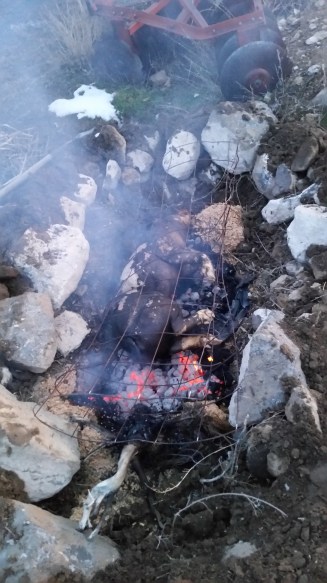
The first part of February also brought our first pig roast. We had a Super Bowl party/birthday party for the farmer and decided that was great time to e20160206_181331xperiment with roasting our first pig. Who doesn’t want to be invited to a party to eat an experiment?!!!  Be aware before you read on, how we cooked this pig may sound or actually be a little redneck-ish, but, hey, that’s just how we are. We started it the night before in a pit we lined with rock. We started wood pellets and 10 pounds of charcoal briquets on fire and got it hot and cooked down. We torched the hair off the pig with a weed burner and wrapped the pig in woven wire and put it in the pit. Then cover the pig and pit with a piece of tin roofing. It cooked and smoked all night. We checked it periodically and rotated it a couple of times. We thought it was done at noon the next day, but we didn’t take it out of the pit until 3:30. The Farmer put the whole thing in a large cooler and brought it in the house. When we were ready to eat, we started cutting it up and taking chunks off. It was good, although, I like my meat well seasoned. So I can’t say it is my favorite way to eat pork. But it was a fun experience and very neat to have a whole roasted pig for all the guest to see before we ate.
 

The sight and sound of new life really is in the air of our farm now. Our chicks have arrived and the brooder is full. This causes great excitement and happiness on our farm. Spring, hope, growth, energy and life are in the air and happening at Agrarian Harvest!DSCN7272

2016 CSA

We are now accepting applications for our 2016 CSA season. It is cold out now, but it is our time to plan for the coming season and order our seed. We work hard all summer and now that it is cold we are spending time together with family, reading books, and planning for the coming year.

If you view the attached pdf document you can view our list of produce that we plan to grow. If you sign up early, we can add requested products to our seed order. Our application is also in the attached document and can be mailed in.

To see pricing and for details, you can view our CSA page, open the pdf below, call us, or email us at myfood@agrarianharvest.com

As a note, we have specific dates and times for pickup. They can be viewed on our CSA page and on the CSA application. If you and friends or coworkers sign up, it may be possible to add locations and times as long as they fit with our farming schedule.

AgrarianHarvestVegetableShareApplication

Produce And New CSA Opportunity Available

Farmers’ Market may be over, but you can still get fresh, local, organic produce all winter long!

AGRARIAN HARVEST has produce, eggs, meat and other products available all year round. At the moment, we have organic eggs, winter squash, pumpkins, kale, swiss chard, garlic, broccoli, turnips, diakon radishes, cabbage, celery, pork, chicken, herbs, soap, laundry detergent, herbs and more. Visit our product pages to get a full list of products and availability. We will have whole, frozen chicken; pork by the cut; whole pigs and eggs all winter long. As for all the produce, it will be available until we sell out of the pumpkins, butternut squash, spaghetti squash, cabbage, turnips, diakon radishes, celery, beets and herbs. The broccoli, kale, swiss chard will be available until it freezes too hard for these plants. Some winters, like last year, we have kale all winter long.  We start growing greens and radishes in our cold frame during the winter so they will be available in early, early spring. So whenever you are in need of fresh produce, check with us first.

Also, we will be offering CSA shares this coming year. There will be two different sizes of produce CSA and a meat CSA with multiple pick-up locations to pick from. If you are interested in buying a CSA and want to the guarantee that you will get a box of fresh, organic, wholesome produce every week, contact us to sign up. Watch for our CSA page later this month for details.

E-mail us at myfood@agrarianharvest.com or call/text us at (208) 308-5332. You can visit us at our farm in Buhl to get product any day of the week or we deliver to Twin Falls on Wednesdays.

Sweet Potato Project

Recently, we watched the movie Faith Like Potatoes and it made me think a lot about our sweet potato project. You can’t see what is growing beneath the ground, you just have to have faith. I try to look at the positive in all things, which I have a hard time doing. Sweet potatoes aren’t suppose do well or even grow at all in our area . . . . .  they grow in warm climates and are of tropic origin, our climate is far from tropical . . . . . .  so we set out to do the impossible once again, to grow sweet potatoes. We had to see for ourselves what would happen when we planted those unusual sweet potato slips. Honestly, we expected the project to be a failure. But, I guess, deep down we had to have a little faith and just not realize it or we wouldn’t of even bought the slips and planted them to begin with.

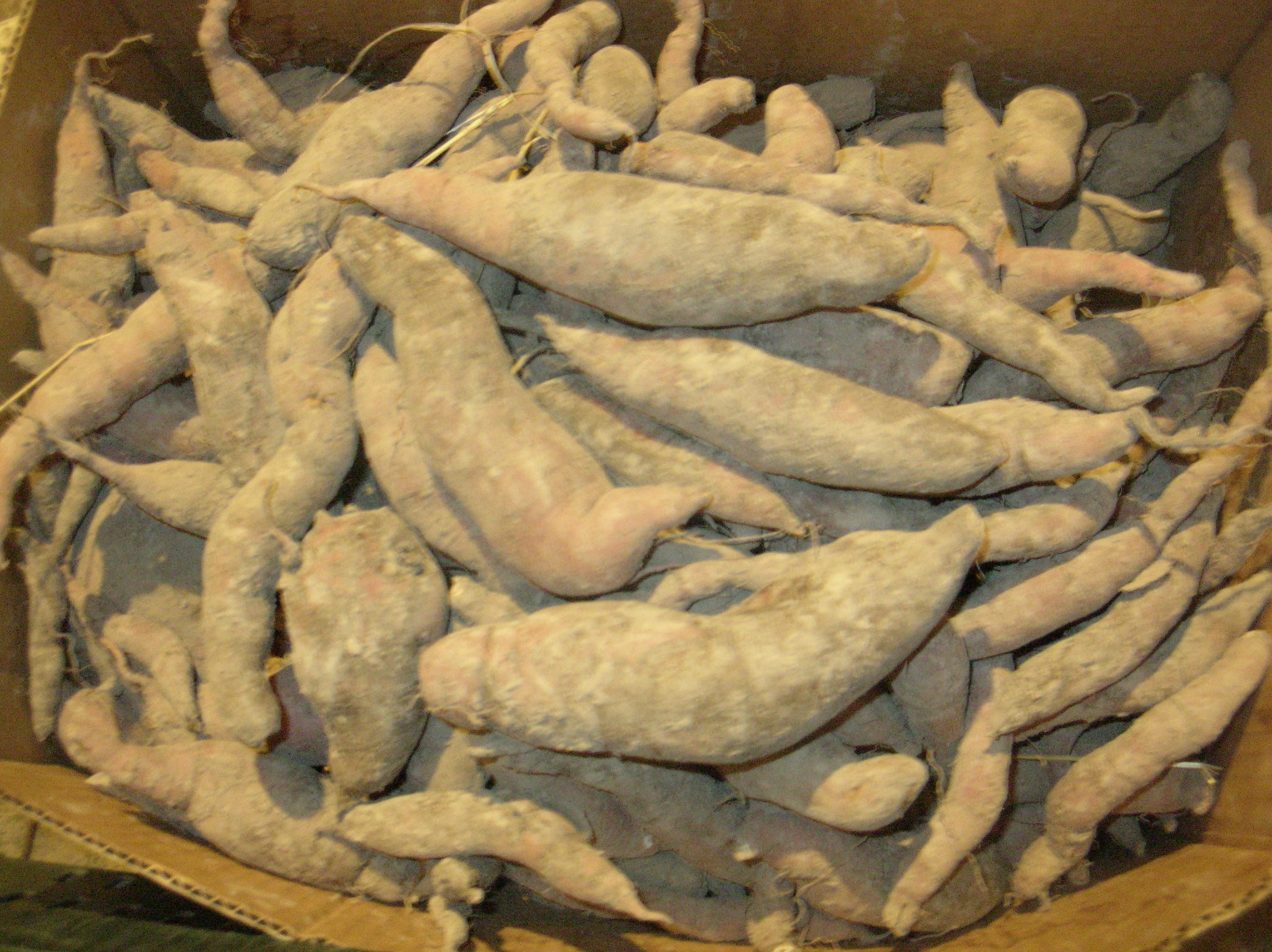
We expected a crop failure, but honestly it wasn’t that bad. Harvest is much different than regular potatoes, aka Irish potatoes that Idaho is famous for growing, which takes getting used to. Sweet potatoes are a root and not a tuber like Irish potatoes. The root is about 20 inches long with a swollen part in the middle that is the actual sweet potato. There were some that had two swollen parts or sweet potatoes on one root. The whole root thing makes them harder to dig and get out of the ground. You have to start digging 18 inches away from the plant, being careful not to poke or scratch the roots. They bruise easily.

We have learned they need lots of room to grow. The ones that were planted 24” apart as recommended had all small tubers, but the one that we planted 36” apart had larger tubers under them. And the vines spread and cover several rows and any plants that are growing near by. To make digging a little easier, we mowed the tops of the plants off before digging. And as with most task around here, we did it the hard way; we did all the digging by hand with a digging fork. Though we had a couple of nice sized potatoes per plant, there are a lot of small tubers. But, hey, they grew and we have sweet potatoes!

DSCN7089

Sweet potatoes are not very sweet when they are first dug. They have to sit and cure at a warm temperature (80 degree F) for 10 days to get their sweetness and set their skin. After they have cured, they need to be stored in a cool, dry location that stays above 50 degrees, ideally between 55 – 60 degrees, and should never be refrigerated (until after they are cooked, of course).

After digging those large sweet potato roots that never should’ve grown in our soil, it makes a person think and believe. It was amazing to see those large tubers come out of our soil. This project has taught me to have faith no matter how impossible the task, project or plant may seem. Have faith no matter how impossible things may seem or how many times you are told it can’t be done.

Our New Family Favorite

We have not had our first frost yet. It has been cooling down though. We can now feel the coolness in the house every morning, which means that we are now starting a fire every morning to take the chill off. Then I am looking out the window at all the produce we still have growing and start to think of what I can cook  using this wonderful abundance of produce.

So I’m going to share a recipe that I have made repeatedly this year. BaBa Ghanoush (pronounced bah-bah-gah-noosh); this amazing dip has become a household favorite. We use it for meat or veggies; great with tomatoes, cucumbers, carrots and celery. It can be spread on crackers, sandwiches or put on a salad. The kids have actually gave up ranch and request this dip instead. And it uses several eggplant that I used to look at and wonder how are we going to use all these eggplant. That is not a problem this year. I now make several batches of this at a time and freeze some so we can enjoy this wonderful dip all winter.

BaBa GhanoushDSCN7078

2 large round eggplant or several of the slender Chinese eggplant (1 pound)

2 TBSP Olive Oil

2 cloves of garlic

2 TBSP basil or if you cook like I do, just use a handful

1/2 tsp salt

2-3 TBSP lemon juice (optional) I don’t use the lemon juice; I don’t like the lemon taste and don’t mind the dip turning brown.

Preheat oven to 350 degrees. Cover a baking sheet with aluminum foil. Wash the eggplant and use a fork to prick each eggplant all over. Put them on the baking sheet and place in the oven.  Cook for about an hour or until they start to collapse. You will know if they are done if they are soft inside. Let cool, until they are cool enough for you can handle them.

Split the eggplants open and use a spoon to scoop the inside (flesh) out, putting it into a food processor. Add the remaining ingredients and process until smooth. You will still have some seeds in the mixture. If you don’t want the dip to turn brown, then add 2-3 TBSP lemon juice and mix. Scrape the dip into a bowl and serve.

Blog at WordPress.com.

Up ↑